Drugs for Weight Loss and for Treating Type 2 Diabetes
Introduction
“In the film ‘YOLO’ which she herself directed and starred in, Jia Ling played the role of a boxer, who transformed from a plump homebody into a muscular athlete. To achieve this role, the actress first gained 20 kg, before losing over 50 kg, essentially shedding ‘half her own self’. Both the narrative of the film and Jia Ling’s weight loss journey were highly inspiring.” (Note 1)

Regardless of age and gender, those who are conscious of their health are well aware that “obesity is a major contributor to chronic diseases”. There is a flood of weight loss products out there that cater to people’s desire to achieve a slim figure. Looking at Jia Ling’s success, her choice of suitable diet and “intermittent fasting” and her strong will and unwavering perseverance are truly admirable. Earlier, I read two articles written by a nutrition expert titled “Obesity – The Culprit of Chronic Diseases” and “Finding a Dietary Pattern to Manage Your Weight” (Note 2), which prompted me to write this article.
Three ways to control your weight
It is sensible to “maintain a balance between food intake and energy expenditure” and avoid overeating, as excess calories from food will be converted into fat and stored in the body. Every day I check my blood pressure and body weight, setting a limit of 70 kg for myself. Occasionally the limit is exceeded after a 2-3-day culinary tour, but my weight will be restored after a week as long as I limit my food intake to 80% of the usual intake in the following few days. It is essential to maintain a moderate amount of “aerobic exercise” daily, such as by simply walking 10,000 steps every day. For some individuals, however, losing weight proves difficult due to various factors. Is medication a viable option for achieving weight loss?
While information is available online (Note 3), there is no need to make much ado about nothing, as “overweight individuals” need to meet the following criteria before actively seeking medical attention and taking weight loss medication:
- A Body Mass Index (BMI) over 30
- A BMI over 27, while also having high blood pressure, high cholesterol, or type 2 diabetes
As of April 2025, the U.S. Food and Drug Administration (FDA) has approved seven weight loss medications for prescription or over-the-counter use. Their brands, active pharmaceutical ingredients, mechanisms of action, and efficacies are listed in the table below:
| Brand | Active Pharmaceutical Ingredient | Mechanism of Action | Efficacy |
|---|---|---|---|
| Xenical | Orlistat | Inhibits lipase in the gastrointestinal tract and thus inhibits fat absorption. | Weight loss of 5% after one year |
| Allia | Orlistat | Inhibits lipase in the gastrointestinal tract and thus inhibits fat absorption. | Weight loss of 5-10 pounds following a daily 60-mg dose for 6 months |
| Contrave | Bupropion-Naltrexone | A combination antidepressant and opioid antagonist. | Respective weight losses of 5% and 10% among 20% and 40% of users |
| Saxenda | Liraglutide | Stimulates GLP-1 receptors in the brain to control appetite. | Respective weight losses of 5% and 10% among 63% and 33% of users |
| Qsymia | Phentermine topiramate | Increase the activity of the neurotransmitter GABA, which can suppress the appetite of individual | An average of 7.1% body weight loss after one year |
| Wegovy/Ozempic/Rybelsus | Semaglutide | Stimulates GLP-1 receptors in the brain, making one feel full. | Weight loss of 10% among 70% of users |
| Mounjarob | Tirzepatide | Mimics the functions of both GLP-1 and GIP hormones to slow down food digestion. | Significant weight loss for users with exercise and proper diet |
aOver-the-counter medication; bWeekly 5-15 mg subcutaneous administration.
Mechanism of Semaglutide
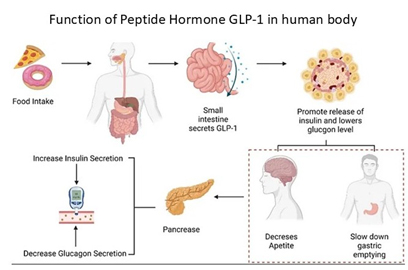
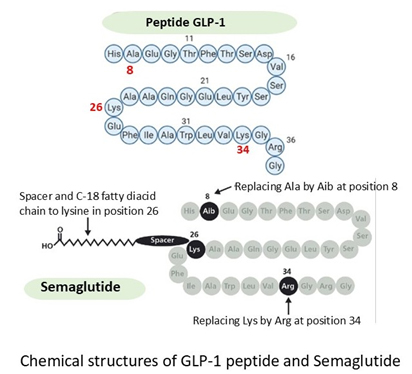
Semaglutide was developed by the Danish biopharmaceutical Novo Nordisk. It first received U.S. FDA approval in 2017 under the brand name Ozempic for treating type 2 diabetes. Later it was marketed as Wegovy, a weight loss medication subcutaneously injected monthly in doses of 0.25/0.5/1.0/1.7/2.4 mg. In 2019, the company introduced the more convenient oral version as Rybelus, which, along with exercise and a low-calorie diet, can effectively control type 2 diabetes (Notes 4-5). Based on the mechanism of action of semaglutide, it is a GLP-1 receptor agonist. In our wonderfully made bodies, after eating, the small intestine secretes the GLP-1 polypeptide hormone, a fixed sequence of 37 amino acid monomers. This hormone immediately stimulates the pancreas to release insulin, while the liver simultaneously lowers glucagon levels, slowing down the digestion process. However, the stability and lifetime of GLP-1 in the body are extremely limited, decomposing within 1-2 minutes. To prolong the function of the GLP-1 polypeptide, medicinal chemists have decorated this polypeptide molecule, by modifying some functional groups in the GLP-1 polypeptide molecular structure, and by adding a lipophilic 18-carbon fatty acid branch to the 26th amino acid, leading to the ultimate design of semaglutide. With a half-life now extended to one week, semaglutide reduces the user’s feeling of hunger. The drug can play two functions: (1) maintain a healthy glucose level in the body; (2) reduce the user’s appetite. The former allows treatment of type 2 diabetes, while the latter prompts weight loss, thus killing two birds with one stone via effective drug design. This drug has also been approved for use in Hong Kong.
Striving for Excellence in Drug Design
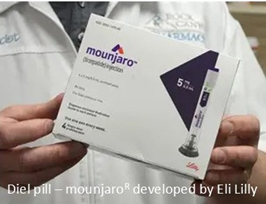
Type 2 diabetes is a serious chronic disease, affecting an estimated 589 million people aged 20-79 globally and causing approximately 3.4 million deaths annually. Therefore, developing effective and innovative treatments for type 2 diabetes with minimal side effects is a major R&D priority for pharmaceutical companies worldwide. Last October, Hong Kong’s South China Morning Post reported the announcement by the American multinational pharmaceutical Eli Lilly of the regulatory approval of its prescription weight loss and type 2 diabetes drug, Mounjaro, for subcutaneous injection (Note 6). The active pharmaceutical ingredient, tirzepatide, shares a similar mechanism of action with semaglutide, but boasts a superior design, with its activity reported to be three times that of semaglutide. This agonist is designed to mimic two human polypeptide hormones, namely glucose-dependent insulinotropic polypeptide (GIP) and glucagon-like peptide-1 (GLP-1), thus slowing down food digestion.
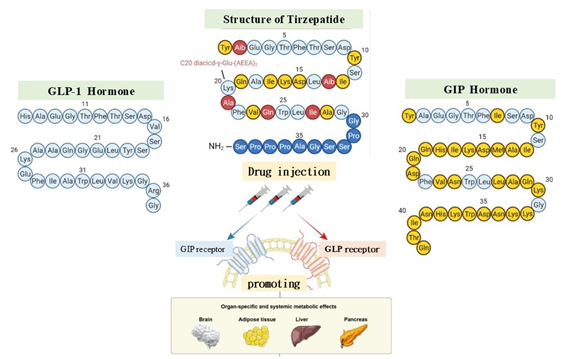
The chemical structure of this synthetic polypeptide drug, shown above, consists of 39 amino acid monomers. It mimics the sequences of the naturally occurring polypeptide hormones GIP and GLP-1. A C18 fatty acid branch connected via ethylene glycol units is deliberately inserted into the centre of the polypeptide chain. This seemingly simple structural modification increases the metabolic lifetime of the drug and enhances its efficacy. When administered subcutaneously, the drug binds tightly to both GIP and GLP-1 receptors, triggering a signaling cascade. The GLP-1 biochemical pathway stimulates insulin release and enhances gastric satiety, while the GIP biochemical pathway influences lipid metabolism and regulates adipose tissue function. Clinical trials have shown that this drug enhances insulin sensitivity and improves glycemic control, demonstrating efficacy in treating type 2 diabetes (Note 7).
Postscript
In recent years, artificial intelligence (AI) has rapidly developed with applications reaching new widths and depths, including the acceleration of the development of new drugs. Imagine the emergence of an innovative and effective treatment for type 2 diabetes. It could alleviate the suffering of many patients and their families, a truly long-awaited blessing for them! From a drug development perspective, the key research question is how the screened drug candidates bind to their target proteins to produce their pharmaceutical effects. In the past, determining the way a protein folds into its three-dimensional molecular structure required considerable time and effort. Nowadays, thanks to the support of AI and big data, the time required has been significantly shortened. Half the Nobel Prize in Chemistry 2024 was awarded to Professor David Baker, Director of the Institute for Protein Design at the University of Washington, U.S.A., for his computational design of novel proteins with practical use in medications, vaccines, and nanomaterials. The other half was awarded to Demis Hassabis and John Jumper, AI researchers at Google Deepmind based in London, UK, for their design of the AI computational program AlphaFold2, which can predict the structures of 200 million protein molecules. Today, over 2 million scientists in 190 countries worldwide are using this program to explore medical and technological applications (Note 8). This scientific contribution will have a profound and positive impact on human life in the 21st century!

References
- https://health.udn.com/health/story/6032/7777776
- Authored by Ms TANG, K L Susan, Nutritionist.
- https://www.verywellhealth.com/7-fda-approved-drugs-for-weight-management-7568596
- C&EN News, American Chemical Society, Jan 20-27, 2025, P.27.
- https://www.drugs.com/semaglutide.html
- https://www.scmp.com/news/hong-kong/health-environment/article/3285934/hong-kong-approves-celebrity-weight-loss-drug-experts-say-its-not-just-look-good?module=perpetual%20_scroll_0&pgtype=article
- https://biologyinsights.com/tirzepatide-peptide-structure-receptor-binding-manufacturing/
- https://www.nobelprize.org/prizes/chemistry/2024/press-release/
By Prof. Chan W. H.
Translate by Dr. Chan H. T.